From Short Film to Moving Image: Transitions in Film and Art in Contemporary Bangladesh
Lotte Hoek
“I did a double take,” said Nasrin Siraj Annie in the autumn of 2022. “I saw the gap, nearly walked past it, and then thought, what was there?” It took her a minute or so to work out that the Public Library was missing. The modernist building had been a central hub for much cultural activity, its auditorium a mainstay for theatre performance and cinema screenings, its courtyard and café between the Dhaka University Campus and the Bangladesh National Museum always buzzing with conversation and flirtation. A place that would have been hard to miss. Until it was gone and all that remained was a gap. The red brick government building dating from 1954 had been bulldozed in anticipation of a new high-rise complex with mirrored exteriors that would allow the library to achieve “international standards” (Alam 2022, online).
The Public Library as was features prominently in Tareque and Catherine Masud’s documentary Muktir Kotha (1999), which documents the screenings of their earlier film, Muktir Gaan (1995). That film had generated a huge interest and lasting impression, described as changing the way in which the Bangladesh Liberation War was remembered (Mohaiemen 2016). Having failed to find commercial distributors, Muktir Gaan was screened at the Public Library by the filmmakers to large crowds Muktir Kotha documents this response and follows young activists and enthusiast who take Muktir Gaan on the road and screen it in bigger and smaller public venues across Bangladesh. The power of Muktir Gaan’s imagery and narrative about the role of a music troupe during the 1971 Liberation War was galvanised and amplified by its non-theatrical exhibition sites, from village fields and schools to libraries, strengthening its appeal and widening its reach.
The Public Library in Dhaka, then, was not merely an exhibition space. Its deep association with public debate and opinion, with the city’s public infrastructure around the Shahbag intersection, with students, public intellectuals, and in its very library-ness, all contributed to the ways in which Muktir Gaan, and many independent and experimental films like it, were screened and could be understood. The context of exhibition modulated and amplified the experience of seeing experimental, independent, short and art films in Bangladesh. That is, the infrastructure for screening experimental film was a crucial part of its life and meaning.
But now the library was gone, rubble remaining. What does the change to the city and its exhibition sites tells us about changes to the place, form and function of experimental film in Bangladesh? In this short essay, I will show how the changes to the urban spaces, technological infrastructures and aesthetic practices in film go hand in hand. In a nutshell, I will argue that these changes have produced the transition from ‘short film’ to ‘moving image’ in Bangladesh’s experimental film practice.
Modernist Ruins and the Expanded Gallery
“It’s a concerted effort,” a documentary filmmaker suggested over dinner a few months after Annie’s report on the library. She described the public spaces and institutions near Shahbag associated with artists, singers, students, filmmakers and scholars, whose adda would have stretched from inside the Dhaka University campus and Charukala towards the Bishwo Shahitto Kendro (World Literature Centre) further north and the theatres at Bailey Road to the east. This area in the middle of the north-south extensions of Dhaka contains a network of sites where political activists would meet ambitious poets, where tea sellers encountered aspiring filmmakers, and where ideas, jokes and conversation flowed between long-standing friends and accidental passers-by. It is the heart of architecturally and intellectually modernist Dhaka. Here places such as the Public Library have been key sites in the urban infrastructure for meetings and public debate, film screenings and theatre, holding significance in public life much beyond their ostensible function, not only in Dhaka.
In the span of a decade, this modernist area of the city has eroded and transformed almost beyond recognition. Civil spaces long associated with progressive social movements and the cultural forms that articulate and gather its communities of practice, have been progressively foreclosed. One aspect of this transformation has been the changing nature of the city’s built form, in which open architectural shapes set in green spaces progressively make way for difficult to access high-rise buildings, embodying the turn towards privatised, commercial and neoliberal forms of life. Further, as “media has become the infrastructural condition of life” (Sundaram 2015, S300), different logics of gathering and sharing ideas and images, now understood as ‘content’ or ‘information’, have emerged. With the rapid transitions across infrastructural, financial, urban, political, and technological domains, the certainties and symbols of the 20th century have eroded and lie in ruins. These transitions are not unique to Bangladesh but part of 21st century reconfigurations of society in which technological transitions in our everyday lives have transformed the human sensorium and facilitated entirely new ways of sensing and relating to one another under conditions of digitally enabled governance, social media-based modes of publicity, data colonialism, and surveillance capitalism (see Couldry and Mejias 2019; Rajadhyaksha 2023; Sundaram 2026; Terranova 2022; Zuboff 2019). These infrastructural factors were exacerbated by the consolidation of authoritarian rule in Bangladesh that had instituted far-reaching controls over public expression, introduced new legislation and court proceedings, as well as encouraging extra-legal forms of surveillance, intimidation and control, that have survived the political transitions since the 2024 ousting of Sheikh Hasina’s authoritarian government.
And so I asked Annie, what now? “I went to Drik for the opening of an exhibition the other day,” Annie said, “There I see everyone in one go.” Not just the gallery at Drikpath Bhobon but the art gallery as such has emerged as a major site in the shifting spaces of public life and critical media practices, in Bangladesh and elsewhere. In Dhaka, you are sure to meet old friends and new comrades at the openings of major exhibitions at the Drik Gallery, Britto Art Trust’s gallery in Green Road, at Shilpakala, the National Academy for Fine and Performing Arts, or Bengal Shilpalay. The spaces of the fine arts have come to house, and not infrequently fund, the aesthetic forms and practices that in a previous decade might have emerged through film society screenings at the Public Library or as photojournalism for magazines and newspapers. I use the term gallery here not only to indicate a physical space for the display of artworks but also more broadly as a site for the articulation of a history of artistic forms, their critical discourses, and the gathering of its communities of practice. This expanded gallery space is digitally extended across websites and social media platforms, where new aesthetic forms and formations gather and focus these communities.
The change in aesthetic form and exhibition context for contemporary experimental film and moving image practice has occurred alongside the emergence of new types of funding and a new interest in the global art market as a site of speculation (see Selim 2014). The transformation of the art world in Bangladesh through the influx of new benefactors and financial interest in the sector, is comparable to similar and well documented transitions in the Global South (see Zitzewitz 2022; Taylor and Corey 2019). A globally networked, digitally extended environment for artistic production funded through the investment of high levels of private wealth has mobilised artists and aesthetic forms that acknowledge but appear to critique these exact conditions of contemporary global capital, authoritarian and digitally enabled governance and colonial inheritances as a distinct interpretative horizon for such artworks. As the art world of Bangladesh has become incorporated into the biennale machine, the moving image as a site for experimentation has migrated from the perennially underfunded domain of independent cinema and short film to the space of the gallery (and now the platforms of social media companies and OTT media distributors).
At the intersection of changing urban spaces and the new financial dispensation in the contemporary arts, independent experimental film practice has moved from ‘short film’ (as experimental film has been often termed, Akhter 2019: 12) exhibition in public spaces, such as libraries, cultural centres and open fields, to ‘moving image’ practice in such expanded galleries and biennales (figure 1). There it is shown alongside traditional media such as drawing, painting and sculpture as well as the disciplines of performance art, installation, community and activist practice, site-responsive art, and multi-media works. For a generation of filmmakers whose working lives stretches across this time of transition between the early 2000s and now, their works would have at one time been shown in the auditoria of venues like the Public Library but are now being more likely to be encountered in a gallery or curated event. Molla Sagar’s body of documentary and experimental films are a good example of works that move across these types of exhibition practices. The transition from auditorium to gallery changes the context of reception, its link to urban and peri-urban civic spaces, and the communities such works address but also modifies the contexts of production, including financing, and the possibilities of aesthetic forms, such as format or duration. In the rubble of the public library, short film has become moving image.
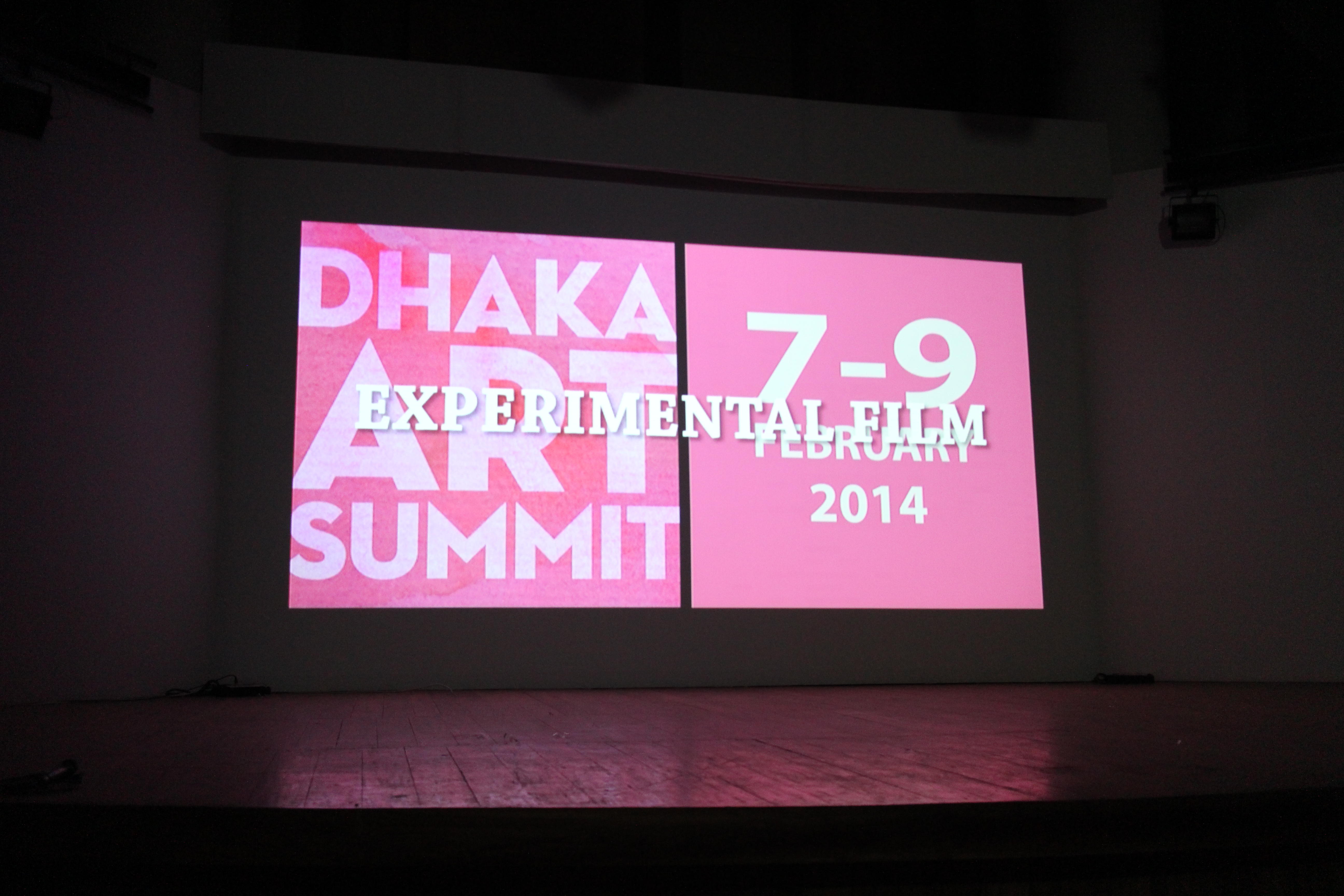
A break in the DAS Films screening programme at the Dhaka Art Summit in 2014. Photography by Lotte Hoek.
Reetu Sattar’s “Lost Tune” & Shabnam
What are the aesthetic affordances of the transition from short film to moving image? That is, what do the changes in exhibition spaces, financing and reception make possible for the practice of experimental film in Bangladesh? When looking more closely at two works by performance and installation artist Reetu Sattar, I suggest that the infrastructural transition has softened the boundaries between film and art and produces a condition where short film may appear as moving image and vice versa.
In 2016, performance and installation artist Reetu Sattar seated a large group of harmonium players in the gardens of Shilpakala, the Bangladesh Academy of Fine and Performing Arts. The performers were dressed in white and black, and included men and women, young and old. Spaced in regular intervals, they sat on the floor behind their instrument, one hand on the keys, one hand on the bellows, and a microphone lain across the top of each instrument for amplification (figure 2). Divided into eight groups, each group of players played only one note continually. Together they produced an unsettling soundscape, atonal and immersive at once. Titled ‘Harano Sur/Lost Tune’, the persistent dissonant sound expressed the themes of the work: the vulnerable place of certain musical traditions in Bangladesh in the context of a political Islam that dismisses cultural forms associated with secular, Bengali, or non-Muslim, traditions and communities. In this performance, the distorted sounds and disappearing aesthetic forms of the harmonium indexed the consolidation of an exclusionary and ahistorical form of Islam in Bangladesh.
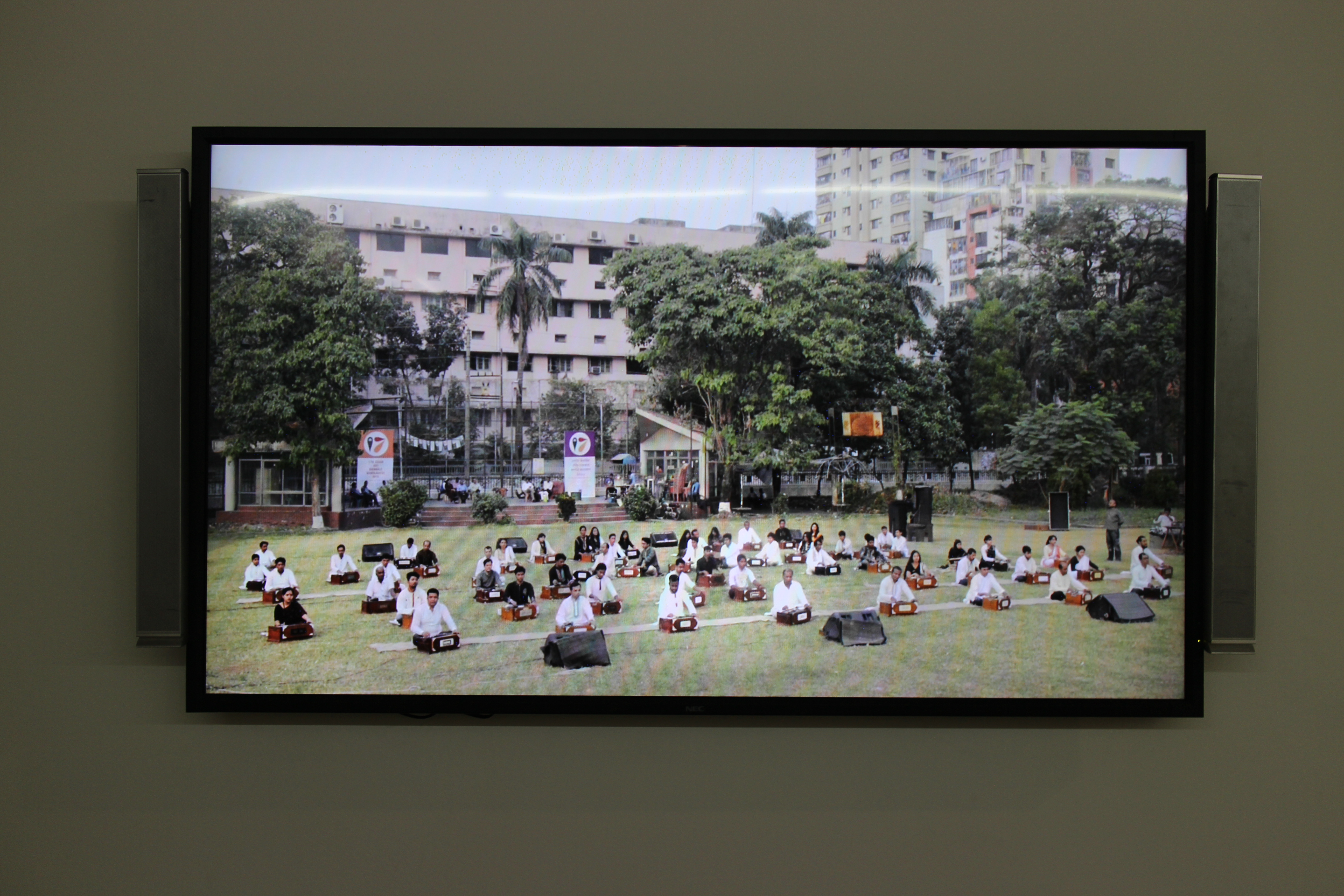
Video registration of Reetu Sattar's "Harano Sur/Lost Tune" (2016) displayed at Palais de Tokyo in Paris, August 2019. Photograph by Lotte Hoek.
“Harano Sur/Lost Tune” was reperformed in a more ornamental version at the Dhaka Art Summit in 2018 and with the Alserkal Arts Foundation in 2019. But this work has circulated much more extensively as a carefully edited and scored film than as a performance. As a film it has been exhibited on screens mounted in galleries such as at the Liverpool Biennial (2018), the Palais de Tokyo (2019), Singapore Art Week (2021), and the Ishara Art Foundation (2021) and the Istanbul Biennale (2022).
But the gallery screen was not the only destination of the recording of “Harano Sur/Lost Tune”. The more elaborate 2018 Dhaka Art Summit performance of “Harano Sur/Lost Tune” was also filmed and edited to produce a 13-minute documentation of the event. This version of the recorded performance was programmed at the 2019 International Film Festival Rotterdam (IFFR). Participating in the Ammodo Tiger Short competition, it now worked as a short film. The performance work “Harano Sur/Lost Tune” and its various audio-visual recordings moved with ease across the blurry boundaries of performance, moving image artwork and short film. Curated or programmed, performed or screened, “Harano Sur/Lost Tune” would shift its form to emerge as an exhibitable work in different sorts of contexts.
A more recent work demonstrates a similar set of movements. Commissioned by the British Textile Biennial in 2021, Sattar made an experimental film titled Shabnam (2023). Working with the history of cotton and colonialism in Bengal, an early cut of Sattar’s evocative film was screened on a loop in the biennial. A few years later it was programmed in a finalised form as a “short” at IFFR in 2023, where it was part of the Ammodo Tiger Short Competition. Another two years later Shabnam was installed alongside performance, installation and sculptural works by Sattar at the 2025 Sharjah Biennial. Like “Harano Sur/Lost Tune” (my inverted comma’s denoting a work of art), Shabnam (my italics indicating a title of a film) moves with ease across the boundaries between film and moving image artwork.
Reetu Sattar’s work shows that the line between film and moving image has softened. With the transformation of the infrastructure for contemporary art and the expansion of funding and resources, short film emerges as moving image and vice versa. As Sattar’s works move across different exhibition contexts and formats, the works shift status. What might have been understood as a short film or creative documentary in one context becomes seen as moving image work in another. And with the change of contexts of display between gallery exhibitions, curated screenings or film festivals, the parameters for reception and interpretation have altered as well.
New Conditions for Experimental Film and Social Commitment
In its search for new ways of exhibiting film and its concern to develop new aesthetic forms to give expression to social commitments, contemporary moving image practice both reprises and inherits from the transformations of the film society movement in 1980s Bangladesh (Haq and Shoesmith 2022; Firdaus 2023). During this decade, the film society embraced the possibilities offered by 16mm film to open up avenues for the shooting and screening of experimental film in non-industrial and non-theatrical contexts. Conceptualised as a parallel or second channel, separate from the mainstream commercial film industry and its political tendencies, 16mm provided new pathways to making and showing new types of films. Morshedul Islam’s Agami (1984) and Tanvir Mokammel’s Huliya (1984) led the trend that was formalised in the Short Film Forum in 1986 (Qader 1993; Raju 2015; Akhter 2019; Haq and Shoesmith 2022). The Forum held its inaugural festival in 1988, where short experimental films were screened in auditoria around Shahbag, including at the Public Library. Independent forms of making and screening were of a piece with the progressive social and politically left-wing commitments that had been part of the film society movement in the country since the 1960 (Hoek 2022). The confluence of shifting technical, political and aesthetic aspects of film culture in the 1980s opened new aesthetic imaginaries and avenues for exhibition that distinctly resemble and resonate in contemporary moving image practice. The Bangladeshi work on display at the 2022 Istanbul Biennale illustrates these imperatives.
Tanzim Wahab’s curatorial project for the Istanbul Biennale was titled ‘Extracurricular’ and brought together works from artists and photographers associated with Pathshala, the South Asian Media Institute. Building on a long history of photographic activism and political dissent, Pathshala has trained some of Bangladesh’s foremost photographers, photojournalists and visual artists. As with the transformation of the short film since the early 2010s, the work of documentary photography and photojournalism has similarly morphed into fine art forms at ease in gallery contexts. Wahab had taken a selection of works from artists associated with Pathshala, where it hung beside other collectives and community groups, such as the New York based Bread and Puppet Theatre. It included a recording of “Harano Sur/Lost Tune”, shown on a discrete screen on a loop, alongside Pranabesh Das’ “Eclipse,” an installation work that maps ideas and concepts from writer and freethinker Avijit Roy against the context of his violent murder at the Dhaka book fair (figure 3). Both “Harano Sur/Lost Tune” and “Eclipse” document in evocative ways the changing socio-political environment of Bangladesh and the repression of practices, forms and communities that index the secular and syncretic history of Bangladesh.
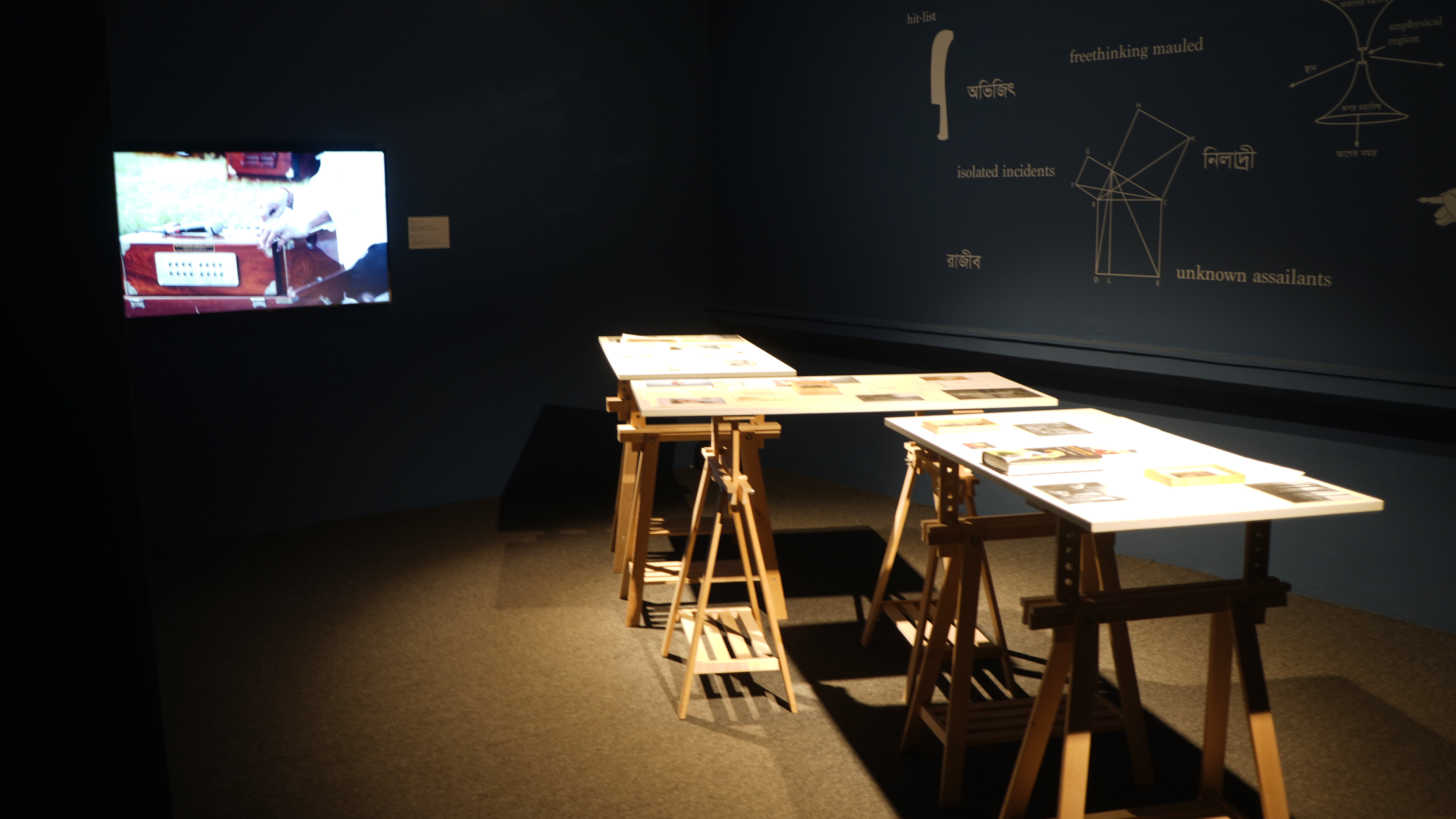
Reetu Sattar's ‘Harano Sur/Lost Tune’ installed alongside Pranabesh Das' Eclipse at the Istanbul Biennial, 2022. Photograph by Lotte Hoek.
The unsettling soundscape of Sattar’s “Harano Sur/Lost Tune” followed you into a second room of the Extracurricular exhibition that was dedicated to the recent history of the Chittagong Hill Tracts. This room too included multi-media installations and invited viewers into the history of the displacement and violent repression of indigenous communities in this district of Bangladesh. Shahidul Alam and Saydia Gulrukh’s ‘Searching for Kalpana Chakma: A Photo Forensic Study’ (2013) used the aesthetics of the forensic investigation in a photographic reconstruction of the disappearance of activist Kalpana Chakma. The photographic images document the silent objects that witnessed the disappearance of the indigenous activist. They were displayed on long light boxes in the darkened room alongside a small screen on which played a short film on a loop that included these images, footage from the opening and display of the works in Dhaka, and a voice over that could be heard through separate headphones.
The group of objects in Alam and Gulrukh’s work sat next to two works that engaged the displacements of indigenous communities because of the damming of the Karnaphuli River at Kaptai in the 1960s. On a large screen behind the light boxes hung Samari Chakma and Naeem Mohaiemen’s video dialogue ‘Autobiography of the Drowned’ (2021) (figure 4). The two narrate the historical moment of the damming of the river in the Chakma and Bengali languages. Made during the Covid-19 pandemic, it brings the images of the two artists together with a mirrored image of the dam. At the other end of the room a video installation from Shamsul Alam Helal ‘Disappearing Roots’ (2018) works was projected onto the wall. The film presents underwater footage of a dummy of the submerged Chakma Royal Palace. Its distinct pastel colour scheme makes it difficult to work out what you are seeing, and to work out whether this was old and tainted archive footage or something else altogether. Hung tightly together, the imagery of these four moving image works ricocheted across the two rooms, with Sattar’s soundscape accompanying the viewer throughout.
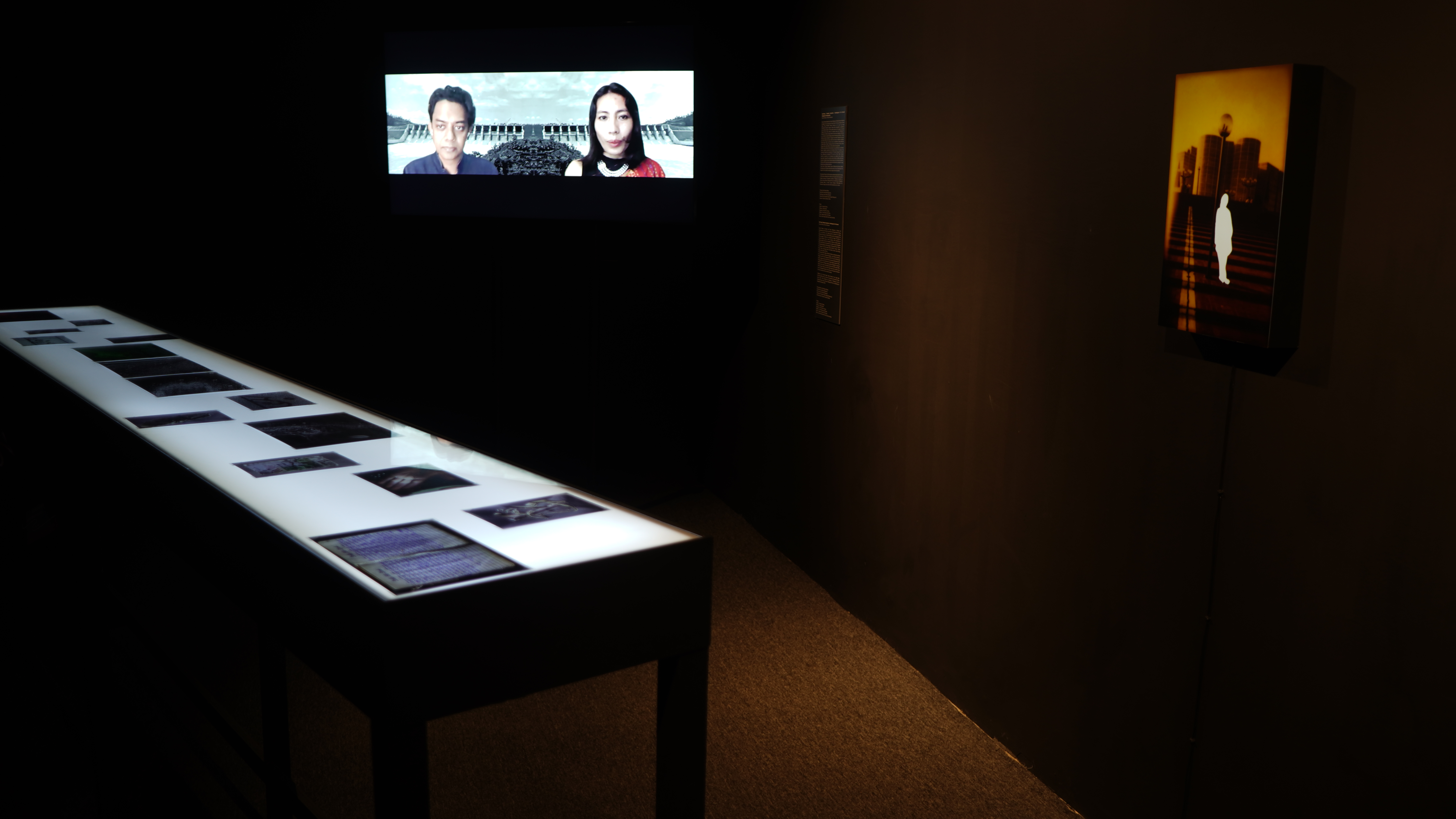
Installation view of ‘Autobiography of the Drowned’ and ‘Searching for Kalpana Chakma’, Istanbul 2022. Photograph by Lotte Hoek.
The display of the Extracurricular works in close quarters and tied together by Sattar’s eery sounds, meant that no viewer could wander through Wahab’s rooms unmoved. The parameters for reception and interpretation of the works here were determined by the affordance of the gallery space. It allowed the moving image practices on display to gain new aspects than if they had been screened individually or sequentially, just as the preference for screening in public spaces had added to the political urgency of the 16mm films of the 1980s. When screened in Istanbul, “Harano Sur/Lost Tune” was a different work than when it was screened as part of the short film programme at the IFFR. In the former context it was screened on a small screen as viewers moved in and out of the room in which it hung, while its sound followed them around. At the IFFR, the film was screened amidst other shorts, for viewers who were sat inside a darkened auditorium, their attention primarily on the large screen. The softening of the boundaries between short film and moving image means that not only do these works appear in different types of places but also that they come to be viewed in completely different ways, profoundly modulating how it is that those works might be received.
Moving image work further inherit some of its political aesthetics from the short film movements’ association with progressive cultural practice in the decades after Bangladesh’s independence. Political commitments can be discerned in the formal qualities of works that draw on artistic practice rooted in (rural) communities or engagements with natural phenomena and the body, for example: Molla Sagar’s immersive collaborations with the Mala community for his Titas project; the contemplative long shots in Yasmin Jahan Nupur’s “Home” (2019); Reetu Sattar’s poetic exposition of the lasting effects of the colonial control of cotton and destruction of weaving practices and communities in Shabnam (2021); or Dilara Begum Jolly’s unflinching reflections on the female body in pain in her multi-media practices, such as in the wall projections in ‘Parables of the Womb’ exhibition (2020). This exhibition also included Jolly’s documentary film Jhothorleena (2018) (figure 5), which, like Sattar’s work, is both screened as film and as moving image practice.
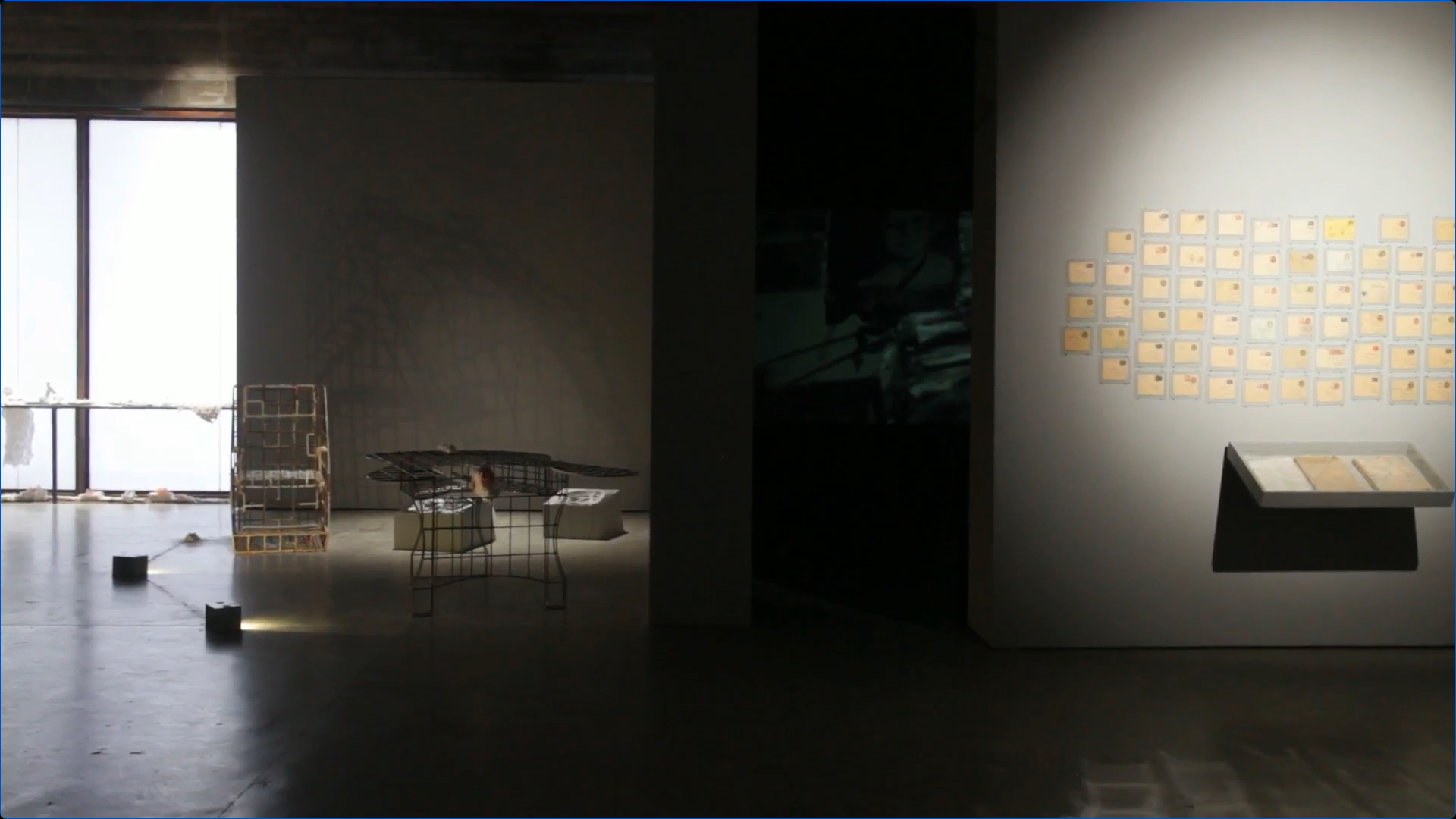
Dilara Begum Jolly’s film Jhothorleena (2018) screens as part of her solo exhibition ‘Parables of the Womb’ at Bengal Shilpalay in 2020. Photograph by Lotte Hoek.
Formal choices in these works move beyond any form of documentary realism. They instead emphasise long duration (such as long durations of observational film), the distancing created by atonality, or the fragmentation of narratives to emphasize historical complexity. They ensure that artistic emphases on cultivation and natural environments, human and more than human forms of kinship, the emotive accounts of struggles for justice and the ineluctability of the body, do not slip into tropes of nativism and the immersive qualities of a certain type of immediacy, certainty and identification. It is these formal qualities that manifest both their experimental form and the socially engaged nature of the works. Together, they demonstrate the deep links between short film from the 1980s and ‘90s and moving image work since the 2010s.
The Moving Image in the Expanded Gallery
When Annie tells me that nowadays, she goes to Drik for a vernissage so that she can see everyone, she participates in the logics that have led to the imbrication of social networks and aesthetic practices by which the gallery has replaced the library. The films she finds there are moving image works that incorporate within their textures the histories of the short film, as well as the changing conditions of exhibition, financing, surveillance and circulation. The changes in material and technological infrastructures, in funding and finance in the art world, as well as in public life more generally, have softened the bounderies between film and moving image art work, while the histories of experimental film and its surveillance continue to exert its pressures on contemporary moving image practice. The resulting works move between festival and gallery, non-theatrical screening to online streaming, and thus become part of our everyday ambient image world.
While the old public library may be gone, the manifold moving image practices of filmmakers and artists that once dwelled there now return newly formatted for the contemporary computational age. The conditions of the contemporary techno-social environment produce the gallery as both a physical space orchestrating the meeting of aesthetic form and social formations as well as a digital platform for circulation and event-ness that extends the physical gallery outwards. Entangled in new financial and artistic institutions, mobilising aesthetic registers of the inexorable, the gallery is now the environment for aesthetic exchange and political solidarity across the long and short durations of the films that loop across its screens.
References
Akhter, Fahmida. 2019. Agami (The Time Ahead, 1984), the First “Short Film” of
Bangladesh: Toward a New Cinematic Aesthetic of Imaging Time and Nation. BioScope: South Asian Screen Studies 10(1): 11-29.
Alam, Helemul. 2022. “Modernisation of Sufia Kamal National Public Library: The end of an
era.” Daily Star 06/08/2022. https://www.thedailystar.net/news/bangladesh/news/the- end-era-3088731, accessed 21/12/2022
Couldry, Nick and Ullises A. Mejias. 2019. “Data Colonialism: Rethinking Big Data’s
Relation to the Contemporary Subject.” Television & New Media 20(4): 336-349.
Firdaus, Imran. 2023. Sharing is Transgressing: Piracy, Film Societies and Independent
Filmmaking in Dhaka. Senses of Cinema 105: online. https://www.sensesofcinema.com/2023/cinema-and-piracy/sharing-is-transgressing- piracy-film-societies-and-independent-filmmaking-in-dhaka/#fn-46579-22
Haq, Fahmidul and Brian Shoesmith, Brian. 2023. Identity, nationhood and Bangladesh
independent cinema. Routledge.
Hoek, Lotte. 2022. The Conscience Whipper: Alamgir Kabir's Film Criticism and the
Political Velocity of the Cinema in 1960s East Pakistan. In Sanjukta Sunderason and Lotte Hoek (eds), Forms of the Left in Postcolonial South Asia: Aesthetics, Networks and Connected Histories. London: Bloomsbury Academic. Pp. 185-212.
Mohaiemen, Naeem. 2016. Simulation at Wars’ End: A “Documentary” in the Field of
Evidence Quest. BioScope South Asian Screen Studies, 7(1), 31–57. https://doi.org/10.1177/0974927616635933
Qader, Mirza Tarequl. 1993. Bangladesher Chalachitra Shilpa [Bangladesh Film Art. Dhaka:
Bangla Academy.
Rajadhyaksha, Ashish. 2023. John–Ghatak–Tarkovsky: Citizens, Filmmakers, Hackers. New
Delhi: Tulika Books.
Raju, Zakir Hossain. 2015. Bangladesh cinema and national identity: in search of the
modern? Routledge.
Selim, Lala Rukh. 2014. “Art of Bangladesh: the Changing Role of Tradition, Search for
Identity and Globalization.” South Asia Multidisciplinary Academic Journal 9 (Online). DOI: https://doi.org/10.4000/samaj.3725
Sundaram, Ravi (ed.) 2026. Twenty-First Century Media Aesthetics and the Political.
Cambridge: Cambridge University Press.
Taylor, Nora A. and Pamela N. Corey. 2019. “Đổi Mới and the Globalization of Vietnamese
Art.” Journal of Vietnamese Studies 14(1): 1-34.
Terranova, Tiziana. 2022. After the Internet: Digital Networks between Capital and the
Common. South Pasadena: Semiotext(e).
Zitzewitz, Karin. 2022. Infrastructure and Form: The Global Networks of Indian
Contemporary Art, 1991-2008
Zuboff, Shoshana. 2019. The Age of Surveillance Capitalism: The Fight for a Human Future
at the New Frontier of Power. London: Profile.
Bio
Lotte Hoek is a media ethnographer whose research is situated at the intersection of anthropology and film studies. Her research explores the public and political life of the moving image in Bangladesh. She is the author of Cut-Pieces: Celluloid Obscenity and Popular Cinema in Bangladesh (Columbia University Press, 2014) and co-editor of Forms of the Left in Postcolonial South Asia: Aesthetics, Networks and Connected Histories (Bloomsbury, 2021). She is one of the editors of the journal BioScope: South Asian Screen Studies. She is Professor of Cultural Anthropology at the University of Edinburgh.
*This is a modified extract from a longer book chapter: Lotte Hoek. 2026. Forms of the Left for the 21st Century: Contemporary Art, Digital Media and Repressive Politics in Bangladesh. In Ravi Sundaram (ed.). Twenty-First Century Media Aesthetics and the Political. Cambridge: Cambridge University Press. Pp. 142-171.