Resources
A slowly growing library of commissioned texts, and online resources on artists’ moving image in Bangladesh.
Commissioned Essays
The Slow Frame: Duration, Stillness, and the Expanded Moving Image in Bangladesh by Imran Firdaus
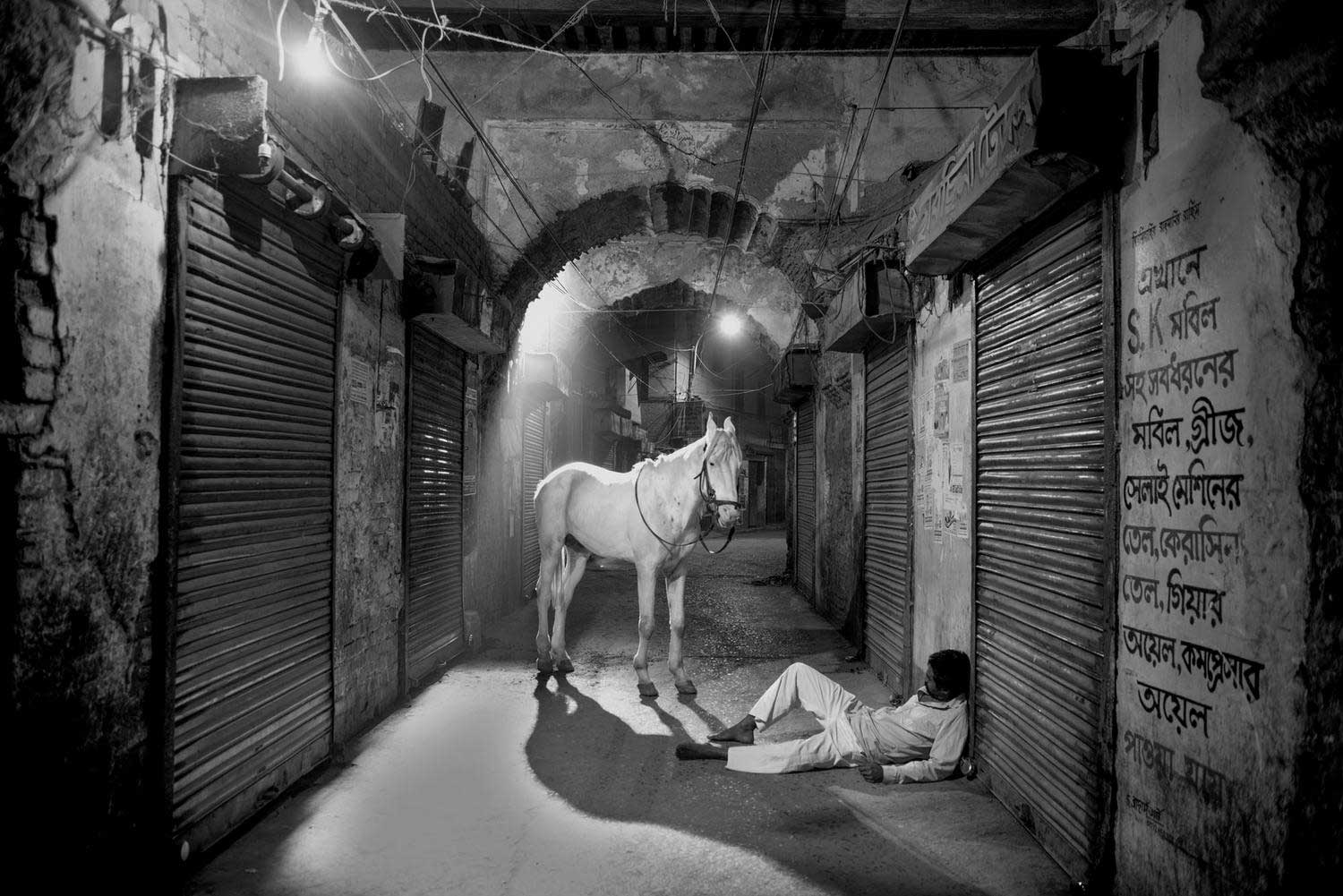
Over the past thirty years, Bangladesh has cultivated a rich, diverse body of moving-image work spanning visual arts, photography, documentary film, and expanded cinema. Despite this output, the field remains largely undocumented in both English and Bangla. This article performs a dual intervention: it identifies slowness as a defining, yet under-examined, formal tendency within this practice and argues that this aesthetic is inseparable from the broader, neglected ecosystem of video installations and essayistic documentaries from which it emerged.
Rather than viewing slowness as a derivative of global slow cinema culture, this study, informed by Gilles Deleuze’s (1985) time-image and Doreen Massey’s (1992) conceptualization of stillness as duration, frames it as a direct response to local material realities. This practice is conditioned by decaying industrial landscapes, suppressed political histories, constrained
economies, and a cinephilic culture fostered by informal film societies and pirated VCD, DVD and P2P sharing circuits rather than formal institutions. In this context, moving slowly with the camera becomes a political act—a deliberate insistence on making visible what is being destroyed, ignored, or erased.
The article explores three interconnected trajectories: the aesthetic and political inheritance of the film society movement; the surge of video installation art at the dawn of the millennium; and the ‘archive of absence’ utilized by artists who employ the essayistic form to navigate unretrievable histories. By examining practices across Dhaka, Chittagong, and the diaspora, the analysis reveals a field that is geographically dispersed, generationally layered, and institutionally underserved. By placing this work within international discourse while addressing the lack of domestic scholarship, the article asserts that documentation is a necessary curatorial act. The moving images already exist and the work has been made; the critical imperative now is to locate, name, and render this vital creative history visible.
Keywords: artists' moving image, Bangladesh, slow cinema, expanded documentary, video
installation, film society, Dhaka, archive.
Moving Image Matters by Parsa Sanjana Sajid 2026
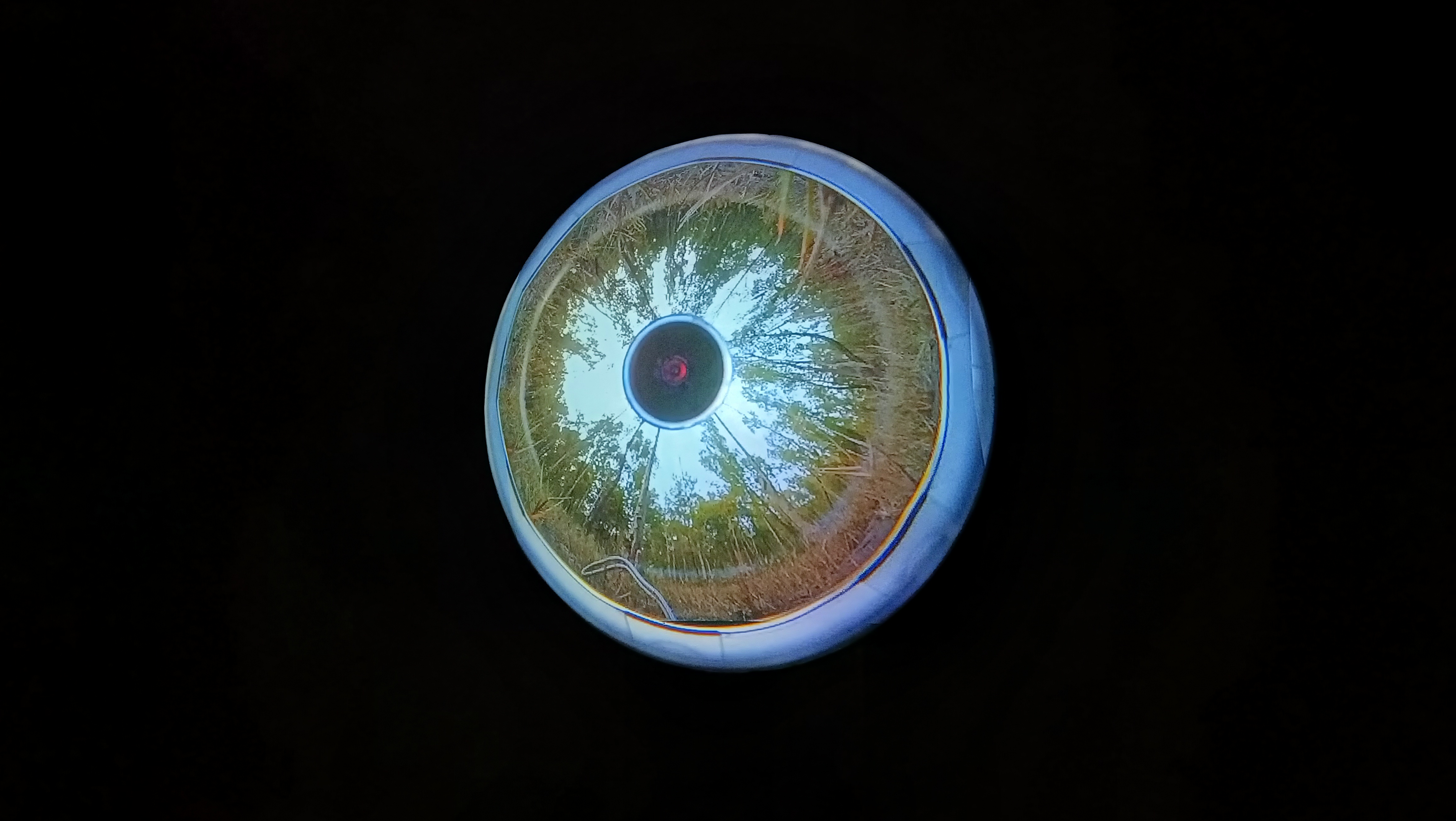
Eye(II), 2024 By Zihan Karim; Loop Video With Audio, 11.00 Min; Photo © Artist
The essay considers the evolving landscape of moving image and visual culture with critical attention to perspective, technique, form, narrative and their relation to pedagogical, institutional and material infrastructures or lack thereof in Bangladesh. Drawing from a heterogeneous catalog of references and visual rituals, moving images straddle experimentation and hyperrealism, speculation and commentary. Although these threads are present among Bangladeshi artists, I also inquire whether a vernacular of novelty and nostalgia (one which primarily relies on sentimental affect of moral approval) emerges in their work. Instead of a survey, the essay aims to understand a. the systemic bases of moving image practice (e.g., with particular attention to the Chittagong Faculty of Fine Arts), and b. the subtexts of visual vocabulary arising therein.
Reading online
Contemporary art and the living film archive in Bangladesh. Lotte Hoek, Third Text Online, 2023. Hoek argues that the film societies of Bangladesh amount to a living archive, and that contemporary artists draw their forms, habits and politics from it, often without saying so. Munem Wasif, Dilara Begum Jolly and the Uronto residencies all pass through.
http://www.thirdtext.org/livingarchives-hoek
Pictures on paper. Lotte Hoek, Terrain, 2019. On the Bangladesh Film Club Act and the censoring of cinematic culture by paperwork rather than scissors.
https://journals.openedition.org/terrain/19361?lang=en#text
Bangladeshi art in the 1990s, Ziaul Karim. Asia Art Archive, Like a Fever. The decade when the boundary of painting was redrawn to admit photography, film and video, told from inside.
https://aaa.org.hk/en/like-a-fever/like-a-fever/bangladeshi-art-in-the-1990s/type/essays
The film and I. Ritwik Ghatak, 1963, republished by e-flux Notes, 2026. Written as Ghatak prepared to leave Calcutta for Bombay, a short credo on why he made films the way he did, impatient with film theory and commercial convention in roughly equal measure.
https://www.e-flux.com/notes/6783480/the-film-and-i
Naeem Mohaiemen by Adam Szymczyk. BOMB, March 2026. On Through a Mirror, Darkly and A Missing Can of Film, with a long exchange about archival tempo, why the contemporary footage holds shots where nothing happens. The most current substantial interview with him online. https://bombmagazine.org/articles/2026/03/16/naeem-mohaiemen-by-adam-szymczyk/
New artist focus: Sarinah Masukor on Naeem Mohaiemen. LUX, 2016. A commissioned text on The Young Man Was series, written from within the UK artists' moving image context.
https://lux.org.uk/new-artist-focus-sarinah-masukor-naeem-mohaiemen/
Sharing is transgressing: piracy, film societies and independent filmmaking in Dhaka, Imran Firdaus. Senses of Cinema, 2023. From the journal's issue on cinema and piracy, and it argues that pirated VHS, DVDs and torrents did more to build cinephilia in Dhaka than any official channel, feeding the film societies, the Short Film Forum lineage and eventually the festival successes of the 2000s. https://www.sensesofcinema.com/2023/cinema-and-piracy/sharing-is-transgressing-piracy-film-societies-and-independent-filmmaking-in-dhaka/
Naeem Mohaiemen’s writing for The Daily Star, Bangladesh’s English language newspaper
https://www.thedailystar.net/author/naeem-mohaiemen
Books
Midnight's third child. Naeem Mohaiemen, Nokta, Dhaka. The book this project takes its name from.
Cut-pieces: celluloid obscenity and popular cinema in Bangladesh. Lotte Hoek, Columbia University Press, 2014. An ethnography of the illegal sexually explicit celluloid spliced into action films, and along the way the best account in English of how films are actually made, screened and unmade in Bangladesh.
Bangladesh cinema and national identity. Zakir Hossain Raju, Routledge, 2014. The first full academic history of the national cinema, framed around the question of which publics it served.
Identity, nationhood and Bangladesh independent cinema. Fahmidul Haq and Brian Shoesmith, Routledge. On the independent and short film movement from the 1980s onward
Forms of the left in postcolonial South Asia. Sanjukta Sunderason and Lotte Hoek, eds, Bloomsbury, 2021. Essays on aesthetics and left politics across the region.
Film in Bangladesh. Alamgir Kabir, Bangla Academy, Dhaka, 1979. Long out of print and not online. Listed anyway, because it is the founding text of film criticism in the country
Watching and listening
Naeem Mohaiemen works on Vimeo On Demand
https://vimeo.com/ondemand/naeemmohaiemen/
Naeem Mohaiemen and Molla Sagar in conversation with Sangita Sen at Berwick Film and Media Arts Festival 2026
In March 2026 Berwick Film and Media Arts Festival and Midnights Third Child presented a special series of screenings of the work of Naeem Mohaiemen and Molla Sagar (https://bfmaf.org/programme-line/focus-mohaiemen-sagar/), you can watch the three conversations that followed the screenings moderated by Sanghita Sen and supported by British Council Connections Through Culture programme and the Durjoy Bangladesh Foundation. The recordings are presented with the kind permission of Berwick Film and Media Art Festival.
Mohaiemen + Sagar 1 discussion at Berwick Film and Media Art Festival 2026
Mohaiemen + Sagar 2 discussion at Berwick Film and Media Art Festival 2026
Mohaiemen + Sagar 3 discussion at Berwick Film and Media Art Festival 2026